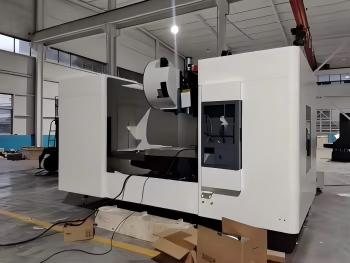
In CNC machining centers, tool vibration and chatter are common challenges that degrade surface finish and machining accuracy. The tool‑holder‑spindle assembly built into the machining center forms the core of the cutting system. Below are practical measures to suppress tool vibration for this machine tool.
1. Optimize Tooling and Setup
The most immediate and effective way to reduce vibration is to increase the rigidity of the machining‑center‑based tool‑holder‑spindle system. This minimizes deflection and shifts natural frequencies away from chatter‑inducing ranges.
- Minimize tool overhang: Use the shortest possible tool length and the largest diameter that fits the application. The longer and thinner the tool, the more prone it is to vibration.
- Use high-rigidity tool holders: Dual-contact spindle systems (like BIG-PLUS) provide simultaneous taper and flange contact, significantly improving rigidity and reducing vibration.
- Consider vibration-damping toolholders: For applications with long overhangs or difficult-to-machine materials, specialized toolholders with integrated damping mechanisms can be highly effective. For example, the Mapal damping system can reduce vibration amplitudes by up to 1,000 times, halving surface roughness values.
- Secure workpiece fixturing: Inadequate clamping, especially for thin-walled parts, amplifies vibration. Support the workpiece as close to the machine table as possible and ensure cutting forces are directed toward the most rigid areas
2. Leverage Active Vibration Control Technologies
Modern smart tooling and control systems can actively counteract vibration in real-time.

- Active toolholders: Systems like an electromagnetic actuator integrated into the tool holder can apply control forces that oppose unstable vibrations. This approach can significantly reduce chatter amplitude and improve surface finish without changing machining parameters.
- Sensor-driven adaptive control: Multi-sensor fusion systems (using real-time data on vibration, spindle load, etc.) paired with adaptive control software can continuously monitor and adjust machining parameters to suppress resonance and interference.
3. Optimize Cutting Parameters and Toolpath
Strategic selection of cutting conditions can help avoid chatter.
- Use stability lobe diagrams: These diagrams map stable and unstable cutting conditions based on spindle speed and axial depth of cut. Operating in stable "pockets" or in the high-speed "infinite stability" zone can completely eliminate chatter.
- Innovative toolpath strategies: For processes like pocket machining, optimizing feedrate and toolpath (e.g., using a spiral tool path) with a chatter-free parameter optimization model can ensure milling stability while also improving efficiency.
- High-speed, multi-flute strategy: Using tools with an extraordinarily high number of flutes (e.g., 20) at very high spindle speeds (e.g., 33,000 RPM) can shrink stability lobes, allowing access to the "infinite stability area" and achieving very high material removal rates without chatter.
4. Advanced Techniques: Intelligent Control
For complex machining, intelligent control systems offer powerful solutions.
- ZVD input shaping: A Zero Vibration Derivative input shaper can optimize the tool's motion trajectory, reducing cutting force fluctuations and vibration.
- Fuzzy neural network control: A five-layer fuzzy neural network controller can adapt cutting parameters in real-time to maintain stability in response to changing conditions.
Case Data
- Active Toolholder Effect: A study using an electromagnetic actuator-based smart toolholder demonstrated significantly reduced chatter amplitudes and improved workpiece surface quality without changing processing parameters.
- Damping Toolholder Effect: The Mapal vibration-damping system reduced vibration amplitudes by up to 1,000 times and halved surface roughness (Rz) from 7.8 µm to 3.9 µm on a long-overhang milling application.
- Sensor-Driven Control: A multi-sensor fusion and adaptive control scheme reduced overall system vibration amplitude while improving positioning accuracy and reducing energy consumption.
- High-Speed, Multi-Flute Strategy: A 20-flute endmill at 33,000 RPM achieved a 2904 cc/min material removal rate with a 110mm axial depth of cut with no chatter.
- ZVD & Fuzzy Control: In a high-speed five-axis application, tool vibration amplitude was reduced from (-14.7, 14.8) μm to (-5.8, 7.8) μm.
FAQ
Q1: What is the most common cause of tool vibration?
Chatter is often caused by a lack of system rigidity, leading to resonance between the tool's natural frequency and the cutting forces. This can be due to excessive tool overhang, insecure clamping, or inappropriate cutting parameters.
Q2: How does tool overhang affect vibration?
Excessive overhang drastically reduces the tool's rigidity. It's one of the primary factors that cause vibration and dramatically increases the chance of chatter. Use the shortest possible tool length for the job.
Q3: What are stability lobe diagrams?
They are charts used to identify stable and unstable cutting conditions based on the relationship between spindle speed and axial depth of cut. By selecting parameters in the stable zones, you can avoid chatter.
Q4: How do active toolholders reduce vibration?
Active toolholders contain actuators that generate counter-forces to oppose the tool's vibration in real-time, effectively damping out the oscillations. This is particularly effective for long-reach or heavy-duty applications.