
A leading CNC machinery manufacturer offering factory-direct pricing and ISO-certified quality, backed by a global footprint in 60+ countries and a lifetime commitment to unlimited technical support.




A leading CNC machinery manufacturer offering factory-direct pricing and ISO-certified quality, backed by a global footprint in 60+ countries and a lifetime commitment to unlimited technical support.
Most metal fabrication workshops rely on horizontal turning equipment for regular parts. However, when it comes to oversized, weighty disk components, vertical turning lathe stands out as an irreplaceable machining solution. Different from conventional horizontal models, this machine adopts an upright spindle structure, allowing bulky blanks to rotate steadily on the horizontal worktable. This article breaks down its unique mechanical design and typical industrial applications to explain why heavy-duty vertical lathe is favored in heavy manufacturing.
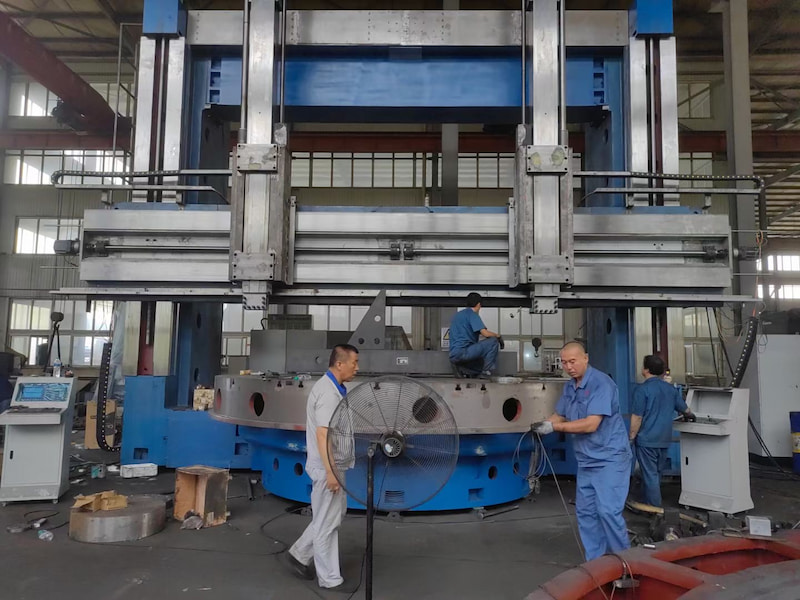
Unique Mechanical Design of Vertical Lathes
The core advantage lies in its vertical spindle arrangement. Workpieces lie flat on the reinforced workbench, and all gravitational pressure acts directly on the rigid table rather than the suspended spindle. This ingenious structure eliminates spindle deflection and premature wear caused by ultra-heavy blanks. Featuring exceptional structural rigidity and load-bearing capacity, this machine is tailor-made for short, thick, large-diameter workpieces that cannot be processed by ordinary lathes.
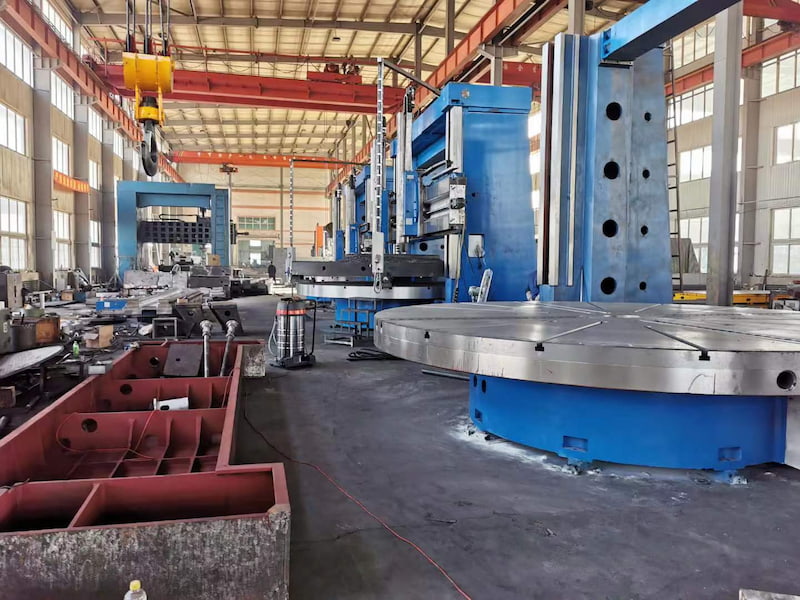
Key Industrial Application Fields
Energy & Heavy Engineering Manufacturing
Energy sector components represent the most typical processing scenarios. Wind power hubs, hydraulic turbine runners, nuclear power flanges and large gear rings often weigh dozens of tons with a maximum diameter of 25 meters. Horizontal lathes struggle to withstand such extreme loads. In contrast, heavy-duty vertical lathe performs both roughing and finishing with stable precision, perfectly meeting the stringent requirements of new energy and heavy engineering industries.
Aerospace & Defense Manufacturing
Aerospace equipment contains a large number of high-precision ring and disk parts, including engine casings, turbine disks and rocket structural components. These workpieces are made of hard-to-machine superalloys with strict tolerance standards. Integrated with turn-mill composite capability, the vertical turning lathe completes outer circle, inner bore, end face and drilling procedures in a single clamping setup, effectively guaranteeing geometric accuracy.
Automotive & Rail Transit Production
For standardized disk-shaped parts in the transportation industry, vertical lathes achieve cost-effective mass production. It is widely applied to process automotive brake discs, flywheels, clutch pressure plates and railway wheel sets. The downward gravity restrains workpiece vibration during rotation, delivering superior surface smoothness and minimal end runout. Matched with automated feeding systems, it forms intelligent high-volume production lines.
General Industrial & Mining Machinery
In general machinery industries, this equipment handles large bearing races, heavy motor shells, gear blanks and mining mechanical parts. It covers almost all heavy ring-type workpieces, serving as universal processing equipment for medium and large mechanical components.
Final Verdict
To sum up, the vertical lathe fills the technical blank of horizontal lathes in heavy workpiece machining. Thanks to its upright spindle and high-rigidity body, vertical turning lathe provides reliable solutions for energy, aerospace, transportation and mining industries. For manufacturers focusing on bulky, high-precision metal parts, a heavy-duty vertical lathe is an essential piece of processing machinery.
Leave A Message
Scan to Wechat/Whatsapp :