
A leading CNC machinery manufacturer offering factory-direct pricing and ISO-certified quality, backed by a global footprint in 60+ countries and a lifetime commitment to unlimited technical support.




A leading CNC machinery manufacturer offering factory-direct pricing and ISO-certified quality, backed by a global footprint in 60+ countries and a lifetime commitment to unlimited technical support.
Introduction
Gears are the “joints” of mechanical transmission. From automotive transmissions and reducers to wind turbine gearboxes and construction machinery motors, all equipment requiring power transmission relies on gears. The gear hobbing machine is the most widely used machine tool for mass-producing cylindrical gears, consistently ranking first in terms of installed base within the gear manufacturing sector. In this issue, we will break down the principles, machine types, processes, and industry value of gear hobbing machines.
I. Gear Hobbing Machine Processing Principles
Gears are cut using the generating method, with the core components being the hob and the workpiece spindle. The hob resembles a worm gear, with its cutting edges covered in teeth. The machine precisely controls the ratio between the hob’s rotational speed and the indexing speed of the gear blank. As the hob rotates and cuts, it simultaneously feeds axially along the gear blank. Through this meshing motion, it continuously mills a standard involute tooth profile onto the blank. In simple terms: The hob and gear blank simulate the meshing of a worm and worm wheel, cutting while meshing to mill all teeth in a single pass.
II. Common Classifications of Gear Hobbing Machines
1. Conventional Mechanical Gear Hobbing Machines: Suitable for general small-to-medium-sized gear machining, such as transmission pinions and agricultural machinery gears. Offers high cost-effectiveness with a traditional mechanical transmission structure;
2. CNC Hobbing Machines: Equipped with a fully servo-controlled CNC system and 4-axis/5-axis interpolation, achieving precision grades 6–7. Suitable for high-precision automotive and wind turbine gears, with automatic gear shifting and feed functions;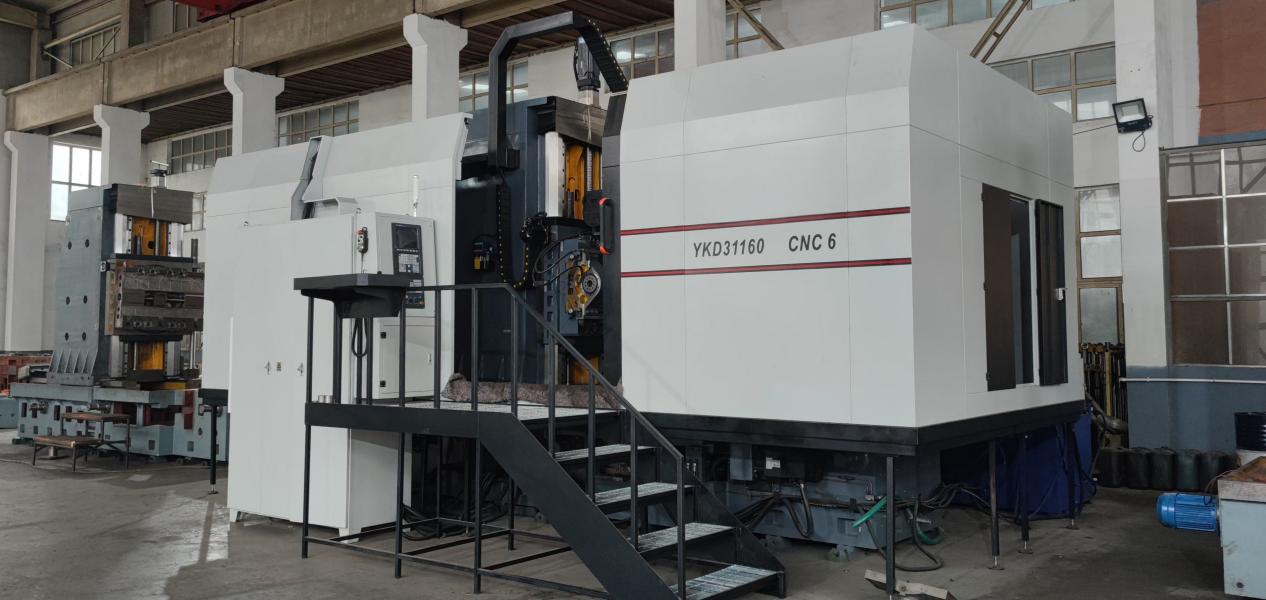
3. Large Floor-Type Hobbing Machines: Designed for extra-large-module gears used in mining, wind power, and marine applications, capable of processing workpieces with diameters up to several meters. These are specialized machines for heavy-duty industrial applications.
III. Advantages of Gear Hobbing Machines Over Other Gear Machining Equipment
1. High machining efficiency: Completes all tooth slots in a single pass; compared to gear shaping machines, production efficiency for large-volume cylindrical gears is more than doubled;
2. High versatility: By simply changing the hobbing cutters, the machine can process straight-toothed and helical cylindrical gears with different module sizes and tooth counts;
3. Controllable costs: Hobbing cutters are less expensive than form milling cutters, resulting in lower unit processing costs for large-scale mass production.
Limitations: Internal gears and double-row narrow-slot gears cannot be processed; for these workpieces, gear shaping machines are typically used as a complementary solution.
IV. Downstream Application Scenarios
1. Automotive Industry: Transmission gears, differential gears, and reduction gear sets for new energy electric vehicles (the primary market for CNC hobbing machines);
2. General Machinery: Gears for reducers, air compressors, and agricultural machinery transmissions;
3. High-End Equipment: Large gears for wind turbine gearboxes, hydraulic transmission gears for construction machinery, and marine power transmission gears.
V. Industry Trends
The boom in new energy vehicles has driven a surge in demand for high-precision gear hobbing machines. Dry hobbing (an environmentally friendly process without cutting oil) and high-speed hobbing have emerged as new technological directions. Traditional, outdated conventional gear hobbing machines are gradually being retrofitted with CNC systems, and gear manufacturing is evolving toward higher precision, automation, and intelligence.
Leave A Message
Scan to Wechat/Whatsapp :