
A leading CNC machinery manufacturer offering factory-direct pricing and ISO-certified quality, backed by a global footprint in 60+ countries and a lifetime commitment to unlimited technical support.




A leading CNC machinery manufacturer offering factory-direct pricing and ISO-certified quality, backed by a global footprint in 60+ countries and a lifetime commitment to unlimited technical support.
Drilling machines are among the most common equipment in mechanical processing. Different types of drilling machines have significant differences in structure, processing capabilities, and application scenarios. Selecting the correct type directly affects processing efficiency and cost. This article provides a comparative analysis of three common types: the column drill, the radial arm drill, and the bench drill.
1.Vertical Drill
The column drill is the most basic type of drilling equipment. Its structure consists of a spindle head mounted on a vertical column. The worktable can be raised or lowered along the column, and the spindle feeds vertically to complete the drilling operation.
The column drill is suitable for machining single holes or a small number of holes in small to medium-sized workpieces. It is commonly found in maintenance workshops, tool rooms, and trial production departments where batch sizes are small.
The limitation of the column drill is that the workpiece must be repositioned after each hole is drilled. It is not suitable for parts with many holes or high hole spacing accuracy requirements.
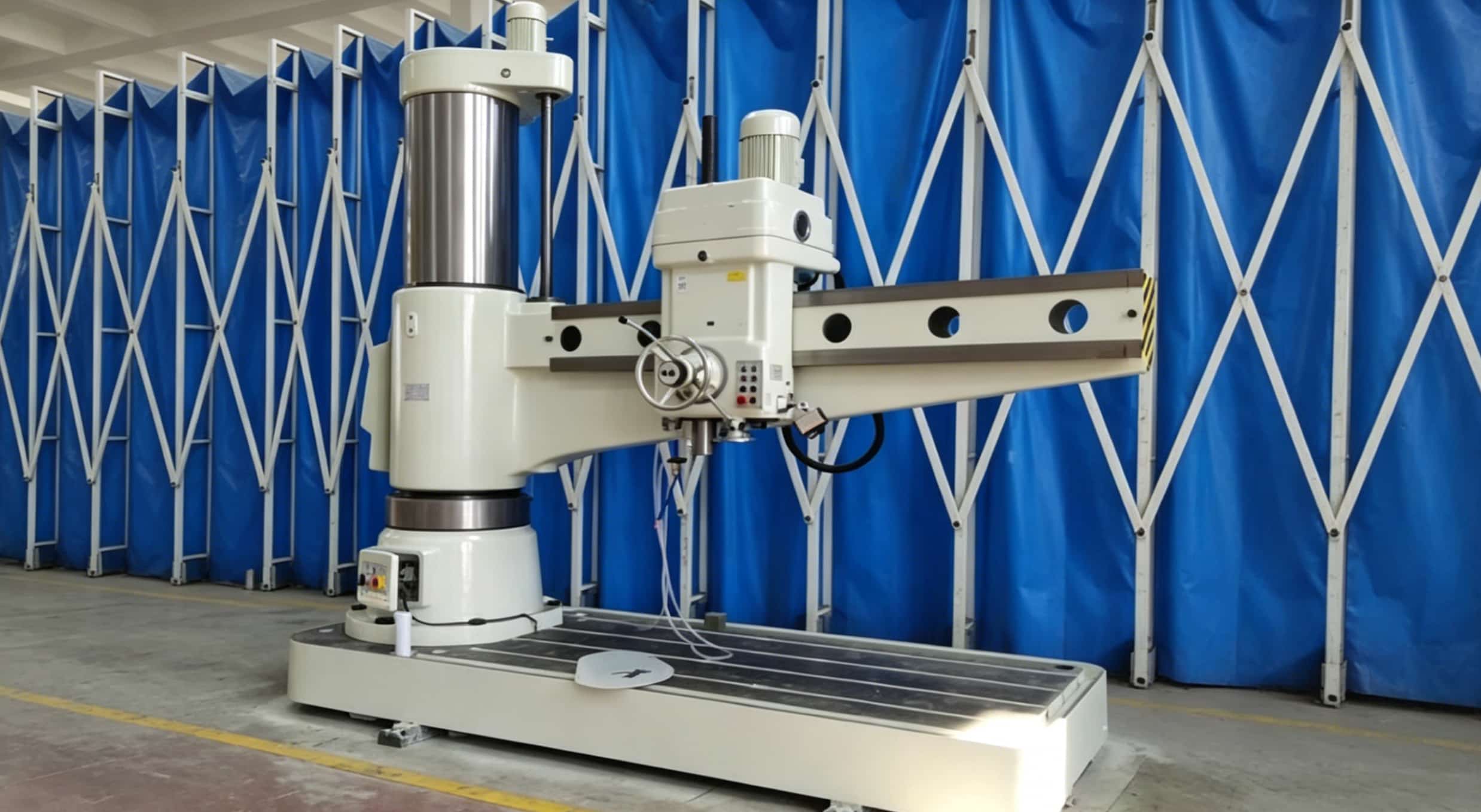
The radial arm drill adds a movable arm structure to the basic column drill design. The spindle head can move horizontally along the radial arm, and the entire arm can rotate around the column and move vertically. This allows the spindle to cover a large cylindrical working space.
The radial arm drill is intended for large workpieces such as boxes, housings, and flanges. It is particularly suitable for applications requiring many holes in a single workpiece, such as tube sheets for pressure vessels or heat exchangers. Once the workpiece is clamped, the operator moves the spindle head and arm to different positions without repositioning the workpiece itself.
The advantage of the radial arm drill is that it eliminates the need to frequently move heavy workpieces. It is well-suited for single-part and small-batch production where workpiece types change often.
The limitations include a large footprint and higher cost compared to column drills. It is not efficient for high-volume production of small parts.
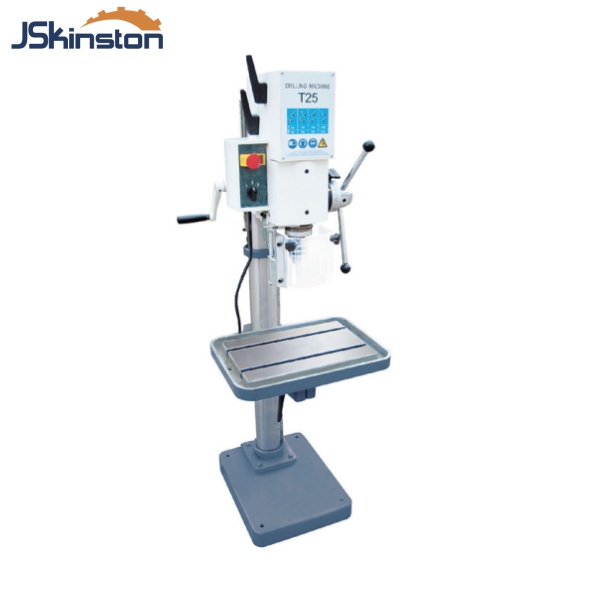
The bench drill is a miniaturized version of the column drill, designed to be mounted on a workbench. It typically achieves higher spindle speeds than larger machines.
The bench drill is intended for small-diameter holes, typically in electronic components, instruments, models, and other precision small parts. It is also common in laboratories, school training shops, and small repair workstations. The high spindle speed makes it suitable for drilling soft materials such as plastics, wood, and thin aluminum sheets.
The limitations of the bench drill include a small working range. It is not suitable for large-diameter holes or deep holes in steel. The manual feed requires operator skill, as feed force is not controlled by an automatic mechanism.
4. Summary of Distinctions
The choice of drilling machine depends primarily on workpiece size, number of holes per workpiece, and batch size.
Bench Drill: Small workpieces, occasional use, small hole diameters.
Column Drill: Medium workpieces, small to medium batch sizes, general-purpose drilling.
Radial Arm Drill: Large workpieces, single-part or small-batch production, workpieces requiring many holes.
5. Selection Guideline
When selecting a drilling machine type, three questions should be considered first.
Does the workpiece size exceed the worktable capacity of a column drill? If yes, a radial arm drill is the appropriate choice.
Is the production volume high? For high-volume production, general-purpose drilling machines are not optimal. Multi-spindle drills or CNC drilling machines should be considered instead.
What is the operator skill level? Bench drills require manual feed control, which demands more operator experience. Column and radial arm drills typically offer automatic feed, reducing the skill requirement.
For most small to medium machining workshops, a combination of a column drill and a bench drill is sufficient for daily needs. Radial arm drills are best suited for manufacturers whose primary products are large structural components.
Leave A Message
Scan to Wechat/Whatsapp :